
En esta página
- **Head-to-head** means **directly competing or confronting each other**, usually between two people, teams, or groups. It can also describe a **one-on-one comparison or debate**, and in some contexts it refers to a **close, even contest**. Common uses: - **Adjective:** a **head-to-head** match, battle, or contest - **Adverb:** competing **head to head** - **Noun:** a direct contest or competition between two sides In sports and competition, **H2H** is short for **head-to-head** and often means the record of previous meetings between two teams.
- Depende de *qué* quieras comparar: no hay una única opción “mejor para SEO” en todos los casos. Google indica que el SEO consiste en ayudar a los buscadores a entender tu contenido y que las bases son el contenido útil, los enlaces internos, los sitemaps y la accesibilidad técnica; además, la guía de Google remarca que el SEO técnico, el contenido on-page y la calidad general del sitio trabajan juntos. Si hablas de **plataformas o CMS**, varias fuentes señalan que **WordPress** suele ser la opción más fuerte para SEO por su control, flexibilidad y ecosistema de plugins, aunque requiere más configuración y mantenimiento. Si hablas de **herramientas SEO**, no existe una “mejor” universal: Semrush destaca como solución generalista, Ahrefs es muy fuerte en backlinks e investigación competitiva, y Google Search Console es clave para datos de primera mano e indexación. Si quieres, puedo decirte cuál es mejor para SEO entre dos opciones concretas, por ejemplo **WordPress vs Wix**, **Semrush vs Ahrefs** o **SEO vs Google Ads**.
- The best time to **switch jobs** is usually after you’ve spent enough time to build credibility and growth - often **at least 2 years**, with **3-5 years** commonly described as the sweet spot. You should consider switching sooner if you’ve stopped learning, feel stuck, or your role no longer matches your goals. Key signs it may be time to switch: - You haven’t learned anything new for about **18 months**. - Your manager has **no clear plan** for your next step. - You can’t picture yourself staying in the same role for another **two years** without losing motivation. - You’re feeling **resentful, plateaued, unseen, drained, or disengaged**. - Your job is limiting your growth, or your salary is below market while your impact stays strong. If this is your **first job**, many career sources suggest staying **6-12 months minimum** unless the role is toxic, unstable, or materially different from what was promised.
- Preguntas frecuentes
**Head-to-head** means **directly competing or confronting each other**, usually between two people, teams, or groups. It can also describe a **one-on-one comparison or debate**, and in some contexts it refers to a **close, even contest**. Common uses: - **Adjective:** a **head-to-head** match, battle, or contest - **Adverb:** competing **head to head** - **Noun:** a direct contest or competition between two sides In sports and competition, **H2H** is short for **head-to-head** and often means the record of previous meetings between two teams.
Depende de *qué* quieras comparar: no hay una única opción “mejor para SEO” en todos los casos. Google indica que el SEO consiste en ayudar a los buscadores a entender tu contenido y que las bases son el contenido útil, los enlaces internos, los sitemaps y la accesibilidad técnica; además, la guía de Google remarca que el SEO técnico, el contenido on-page y la calidad general del sitio trabajan juntos. Si hablas de **plataformas o CMS**, varias fuentes señalan que **WordPress** suele ser la opción más fuerte para SEO por su control, flexibilidad y ecosistema de plugins, aunque requiere más configuración y mantenimiento. Si hablas de **herramientas SEO**, no existe una “mejor” universal: Semrush destaca como solución generalista, Ahrefs es muy fuerte en backlinks e investigación competitiva, y Google Search Console es clave para datos de primera mano e indexación. Si quieres, puedo decirte cuál es mejor para SEO entre dos opciones concretas, por ejemplo **WordPress vs Wix**, **Semrush vs Ahrefs** o **SEO vs Google Ads**.
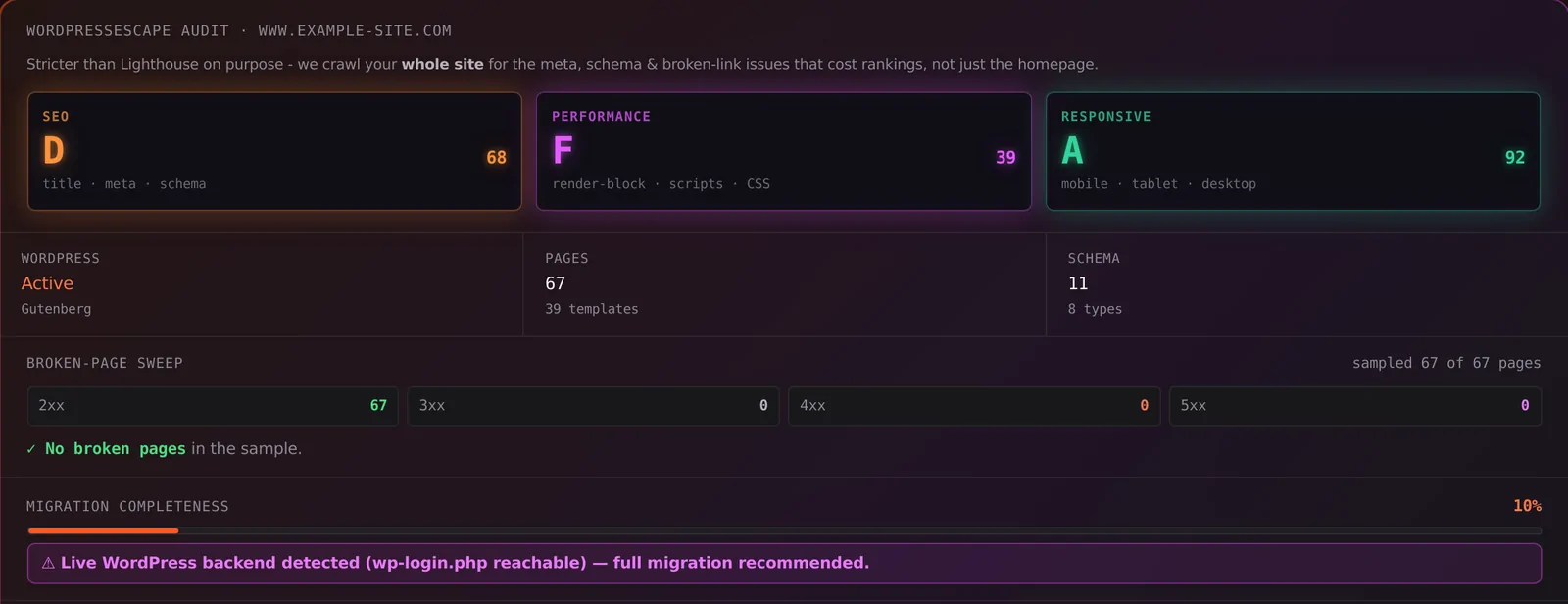
Lo estático destaca en las señales que Google realmente mide. Core Web Vitals son un factor de posicionamiento, y los sitios estáticos se cargan más rápido que cualquier página de WordPress basada en base de datos. Existe el mito de que lo estático “perjudica el SEO”, pero no es así. Conservas los títulos, las metaetiquetas, los canonicals y el schema, y además los sirves más rápido. Mira cómo migrar sin perder SEO.
The best time to **switch jobs** is usually after you’ve spent enough time to build credibility and growth - often **at least 2 years**, with **3-5 years** commonly described as the sweet spot. You should consider switching sooner if you’ve stopped learning, feel stuck, or your role no longer matches your goals. Key signs it may be time to switch: - You haven’t learned anything new for about **18 months**. - Your manager has **no clear plan** for your next step. - You can’t picture yourself staying in the same role for another **two years** without losing motivation. - You’re feeling **resentful, plateaued, unseen, drained, or disengaged**. - Your job is limiting your growth, or your salary is below market while your impact stays strong. If this is your **first job**, many career sources suggest staying **6-12 months minimum** unless the role is toxic, unstable, or materially different from what was promised.
Pásate a Wordpress Escape cuando hayas tocado techo con WordPress: los plugins de caché ya no arreglan tu velocidad, estás cansado de parchear la seguridad o las facturas no se corresponden con los resultados. Si tu sitio es principalmente contenido - un blog, una web de marketing, un negocio local, documentación o un portafolio - una reconstrucción estática es el upgrade que necesitas. Empieza viendo cómo sería tu migración y luego lee cómo deshacerte de WordPress.
Preguntas frecuentes
Yes - **a static site is usually faster than WordPress** because it serves prebuilt HTML directly, while WordPress typically has to run PHP and query a database to generate each page.
The speed gap is often noticeable without optimization: several sources describe static sites as loading in under a second, while unoptimized WordPress sites commonly take a few seconds, especially on mobile or shared hosting. With strong caching, a CDN, and careful tuning, **WordPress can get much closer** to static performance, and in some cases the difference becomes small enough that users barely notice.
So the practical answer is:
- **Fastest by default:** static sites.
- **Can WordPress be fast?** Yes, but it usually needs extra optimization.
- **Best choice depends on needs:** if you need simple content and maximum speed, static is often better; if you need complex editing workflows, plugins, or dynamic features, WordPress may be worth the tradeoff.
Sí: **una web estática suele servir HTML ya construido desde una CDN**, mientras que **WordPress normalmente genera cada página al vuelo** con PHP y una base de datos. Esa diferencia estructural explica por qué las páginas estáticas suelen cargar en milisegundos o menos de un segundo, mientras que WordPress, incluso optimizado, a menudo tarda más.
Yes - **generally, a static site is more secure than WordPress** because it has a much smaller attack surface: no database, no public login page, and no server-side PHP or plugins to exploit.
That said, **WordPress can still be secure** if it is actively maintained, with regular core/plugin/theme updates and good hosting and security practices. The main risk in WordPress comes from the broader ecosystem around it, especially plugins and themes, which account for most reported vulnerabilities.
So the practical answer is:
- **Static site:** fewer components, fewer common attack vectors, easier to secure.
- **WordPress:** more flexible, but security depends heavily on ongoing maintenance and careful plugin management.
If you want, I can also compare **static site vs WordPress security for a business website** in more practical terms.
No del todo. Un sitio estático **sí reduce mucho** la superficie de ataque porque no tiene base de datos, plugins ni procesamiento del lado del servidor en tiempo de petición, así que desaparecen clases enteras de ataques como SQL injection o ejecución de código del servidor. Pero decir que “no hay nada que explotar” es demasiado absoluto: aún pueden existir riesgos en el **hosting**, en el **CDN**, en el **proceso de build**, en **JavaScript de terceros**, en formularios integrados, o por **archivos mal configurados** y dependencias vulnerables. Incluso las fuentes más favorables a los sitios estáticos hablan de una superficie de ataque *mucho menor*, no de seguridad perfecta. La formulación más precisa sería: **“Un sitio estático elimina muchas de las vías de ataque típicas de WordPress, pero no elimina todos los riesgos de seguridad.”**
No. A static site can cover **many** of the things WordPress does, but not **everything**, especially when you need built-in **user accounts**, **membership areas**, **server-side e-commerce checkout**, **real-time search**, or frequent edits by non-technical editors.
What a static site *can* do well includes marketing pages, blogs, documentation, portfolios, and other content-driven sites; static sites are pre-built HTML/CSS/JavaScript files served directly, which is why they tend to be faster and simpler to secure.
Where WordPress still has the edge is in **dynamic, interactive, or highly editable** sites. WordPress generates pages on demand from PHP and a database, which makes it more suitable for complex content workflows, plugin-driven features, and sites that non-developers update often.
A practical way to think about it is this:
- **Static site**: best for speed, simplicity, and mostly fixed or content-focused sites.
- **WordPress**: best when you need a CMS with lots of built-in dynamic functionality and easy editing for non-technical users.
So the short answer is: **static sites can replace WordPress for many use cases, but not all of them**.
Para sitios de **contenido y marketing**, sí: suele ser **más rápido** y más eficiente. Las funcionalidades verdaderamente dinámicas, como **inicios de sesión** o **e-commerce complejo**, se suelen delegar a servicios específicos, mientras que las páginas en sí permanecen **estáticas**.