בעמוד זה
- **Static electricity** becomes a buildup of electric charge on an object, usually when **electrons** move from one material to another during rubbing or contact. If you mean what *“becomes static”* in plain language, it is the **charge** - it stays in place instead of flowing, until it has a path to discharge.
- מה **נשאר מאוחסן/מארח** הוא בדרך כלל **קובצי האתר** שלך - כלומר הקוד, התמונות, ה־HTML, ה־CSS, ה־JavaScript והנתונים של האתר - על שרת שנשאר מחובר לאינטרנט כל הזמן. אם התכוונת ל־**web hosting**, אז זה בדיוק התוכן של האתר שנשאר על השרת; אם התכוונת ל־**homestay** או ל־**hosted stay**, המשמעות היא שהמארח נשאר במקום יחד עם האורחים.
- **What We Don’t Have to Pretend** היא כותרת של טקסט/שיר על כנות, קבלה ואותנטיות, ולא נראה שיש לה משמעות אחת קבועה מחוץ להקשר שבו היא מופיעה. אם התכוונת למשמעות הביטוי עצמו, פירושו הוא שלא צריך להעמיד פנים או להציג משהו שאינו אמיתי.
- שאלות נפוצות
You can do this, but it is **not** a standard “full WooCommerce to Shopify” migration if the **content pages stay at the same URLs** and only `/cart`, `/checkout`, and `/my-account` are redirected. Shopify migration guidance consistently says that *every URL that changes* should get a **301 redirect**, while static pages can be recreated on Shopify and mapped to their new paths if those paths change. What your plan implies: - **Product pages** can be moved to Shopify product URLs and protected with 301s from the old WooCommerce URLs. - **Static content pages** like About, Contact, and FAQ can be recreated in Shopify, but Shopify’s page URLs normally follow a different pattern, so if you want the *same URLs* you would need another fronting layer or hosting approach rather than plain Shopify page hosting. - **Checkout and account** flows are different on Shopify, so redirecting WooCommerce’s `/cart`, `/checkout`, and `/my-account` URLs to Shopify equivalents is a reasonable routing strategy, but those paths do not represent normal static content pages. The key constraint is this: if **WordPress is deleted**, then any page that is still being served from the old WordPress URLs must exist somewhere else. If those URLs remain unchanged, that means the content is no longer being served by Shopify alone; it is being served by some static host, reverse proxy, or similar setup, while Shopify handles commerce. So, in practical terms, your proposal is best described as a **hybrid architecture**: - **Static content** stays at the original URLs on a static host. - **Commerce actions** route to Shopify. - **WooCommerce is treated as replaced**, not as a blocker, because the store logic is no longer running on WordPress. If you want, I can help you phrase this as a migration policy statement or turn it into a concrete URL-routing matrix.
**Static electricity** becomes a buildup of electric charge on an object, usually when **electrons** move from one material to another during rubbing or contact. If you mean what *“becomes static”* in plain language, it is the **charge** - it stays in place instead of flowing, until it has a path to discharge.
דפי בית, בלוגים, דפי מוצר, תבניות בסגנון קולקציה. מהיר, ניתן לאינדוקס, בלי PHP.
מה **נשאר מאוחסן/מארח** הוא בדרך כלל **קובצי האתר** שלך - כלומר הקוד, התמונות, ה־HTML, ה־CSS, ה־JavaScript והנתונים של האתר - על שרת שנשאר מחובר לאינטרנט כל הזמן. אם התכוונת ל־**web hosting**, אז זה בדיוק התוכן של האתר שנשאר על השרת; אם התכוונת ל־**homestay** או ל־**hosted stay**, המשמעות היא שהמארח נשאר במקום יחד עם האורחים.
עגלה, קופה, חשבונות. אנחנו מפנים את הנתיבים האלה ב-301 לכתובת החנות שלך. את/ה מגדיר/ה את זה בדשבורד לפני המעבר.
**What We Don’t Have to Pretend** היא כותרת של טקסט/שיר על כנות, קבלה ואותנטיות, ולא נראה שיש לה משמעות אחת קבועה מחוץ להקשר שבו היא מופיעה. אם התכוונת למשמעות הביטוי עצמו, פירושו הוא שלא צריך להעמיד פנים או להציג משהו שאינו אמיתי.
סריקה היא לא מחסן עם 50,000 מק"טים. נגיד בגלוי: צריך Rebuild או פתרון היברידי. קודם סורקים.
אם הסורק מזהה WooCommerce, המפרט קובע היברידי - לא 'אנחנו לא יכולים לעזור.'
שאלות נפוצות
לא - **WooCommerce** לא יכול לפעול בלי **WordPress**, כי הוא תוסף של WordPress ולא פלטפורמה נפרדת.
אם הכוונה שלך היא “האם אפשר לעזוב את WordPress אבל להמשיך להשתמש ב-WooCommerce”, התשובה היא גם לא; כדי להשתמש ב-WooCommerce אתה צריך אתר WordPress פעיל.
מה שכן אפשר לעשות:
- להסיר את WooCommerce מ-WordPress אם כבר לא צריך חנות.
- לעבור לפלטפורמת מסחר אחרת כמו Shopify או לבנות פתרון מותאם, אם רוצים לעזוב את WordPress לגמרי.
- להשאיר את WordPress בלי WooCommerce, אם האתר הוא בעיקר תוכן ולא חנות.
אם תרצה, אני יכול גם להסביר מהן **החלופות הטובות ביותר** ל-WooCommerce לפי סוג החנות שלך.
Yes - a **hybrid setup** is the right interpretation: keep a **static catalog** on the frontend, and send customers to a **hosted checkout** for payment. In that model, WordPress no longer needs to power the storefront UI; it only stays involved if you still want it to handle checkout, orders, or other backend functions. A few supporting points from the results: - A static-catalog + hosted-checkout pattern is a common hybrid commerce approach: the storefront is pre-rendered, while payment happens on a separate hosted checkout flow. - Hosted checkout services are specifically designed to handle payment collection on a provider-managed page, reducing PCI burden and avoiding custom payment forms. - Several headless-commerce examples explicitly describe the catalog/front end moving away from WordPress while checkout either remains in WordPress or is redirected to a hosted payment page. So if your intent is **“static catalog, hosted checkout, WordPress goes away”**, that is a coherent architecture. The only caveat is that **some backend commerce system still has to own checkout logic, pricing, orders, taxes, and shipping**; it just does not have to be WordPress. If you want, I can also turn this into a cleaner one-line positioning statement for the website.
לא בהכרח. אם המטרה שלך היא **למכור מוצרים אונליין** ורוצה פתרון מהיר, פשוט ומנוהל בלי להתעסק בשרתים, Shopify הוא בחירה נפוצה ונוחה. אם אתה צריך **יותר שליטה, התאמה אישית עמוקה, או אתר שאינו בעיקר חנות**, ייתכן שפתרון אחר - כמו אתר מותאם או פלטפורמה אחרת - יתאים יותר.
בפועל, Shopify מתאים במיוחד ל:
- **עסקים קטנים ובינוניים** שמוכרים מוצרים פיזיים או דיגיטליים
- מי שרוצה **להקים חנות מהר** בלי פיתוח מורכב
- מי שמעדיף **תשלום חודשי קבוע** במקום ניהול תשתית, אבטחה ואחסון בעצמו
Shopify פחות מתאים אם:
- אתה רק **בודק רעיון** עם תקציב קטן מאוד
- העסק שלך הוא בעיקר **שירותים או תוכן**, לא חנות
- אתה צריך **פיתוח מאוד ייחודי** או שליטה מלאה במבנה ובטכנולוגיה
אם תרצה, אני יכול לעזור לך להחליט בין **Shopify**, **WooCommerce** או **אתר מותאם אישית** לפי סוג העסק שלך.
No. Any **hosted checkout URL** works; Shopify is the common one.
If you mean whether **product URLs themselves will change**, the answer is **not necessarily** - in most platforms they only change if you edit the product handle/permalink settings or move the product into a URL structure that depends on categories. In systems like Shopify, changing a product handle creates a redirect automatically; in WooCommerce, only certain permalink structures are affected, and redirects are handled automatically for impacted URLs.
If you want, I can also translate this into Hebrew.
Not if we can help it: keep the **same paths**, and use **301 redirects only** for **/cart**, **/checkout**, and **/account**.
The scan will flag Woo as **hybrid**.
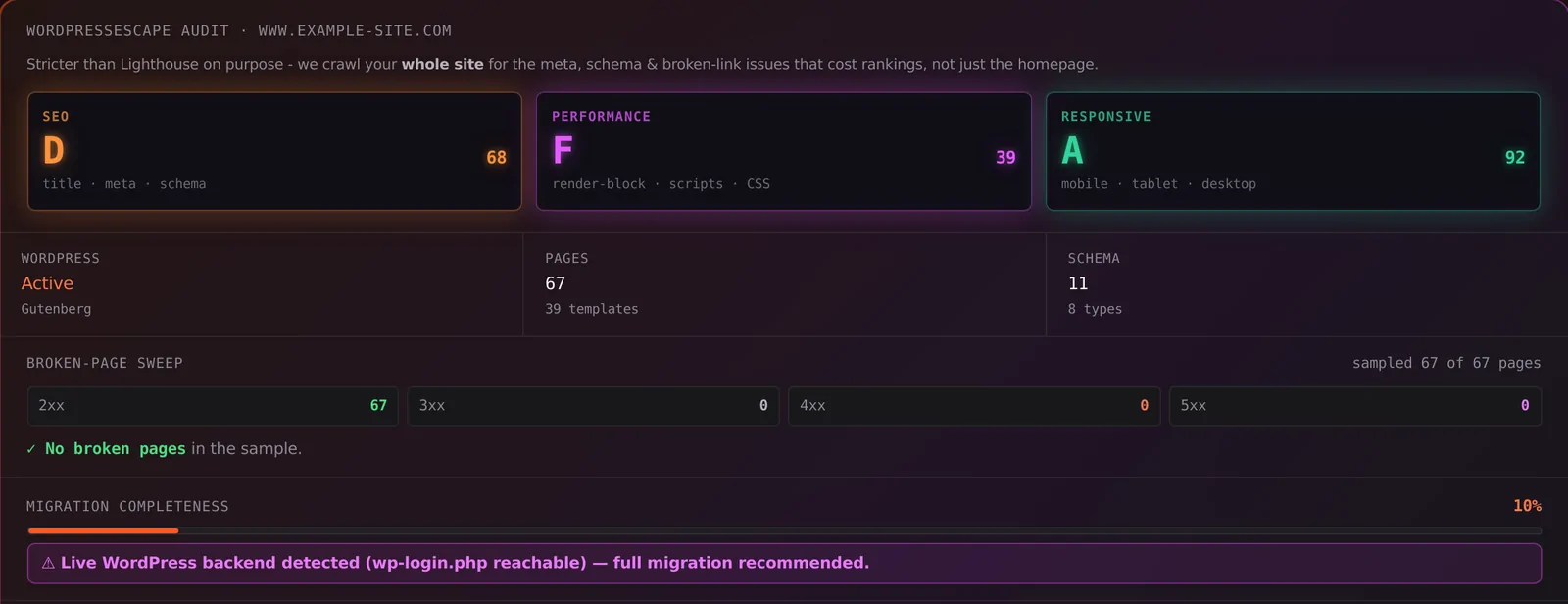
סרוק את ה-URL שלך בחינם - 60 שניות, בלי התחברות. ציוני **SEO**, **ביצועים** ו-**רספונסיביות**, ואז מעבר מסודר ל-escape done-for-you אם תרצה.
סרקו את האתר שלי בחינם